


Understanding BOTIX's 4D Imaging: What Can It Actually See?
 Nov 09.2026
Maritime radar is an essential sensing device for the safety of vessel navigation. In complex scenarios — ports, narrow waterways, and berthing and unberthing operations — conventional navigational radar is constrained by its resolution capabilities, making it difficult to obtain accurate range, precise bearing and clear target contours. To close this capability gap, BOTIX has introduced millimeter-wave radar technology into maritime applications, launching the Marine 4D Imaging Small-Target Radar — BOTIX XSeek. With high-resolution 4D imaging capabilities, XSeek delivers more precise and richer perception data for close-range target detection and precision ship handling, meeting the sensing requirements of a wide range of precision ship-handling scenarios.

What Is 4D Imaging?
In the BOTIX XSeek, 4D imaging refers to four measured quantities: range, azimuth, elevation and velocity. Specifically:
Range measures the distance between the target and the radar, indicating how far away the target is.
Azimuth measures the target's angle in the horizontal plane, indicating which direction the target lies in.
Elevation measures the target's angle in the vertical plane, determining how high or low the target is positioned.
Velocity is measured directly through the Doppler effect, showing how quickly the target is approaching or moving away from the radar.
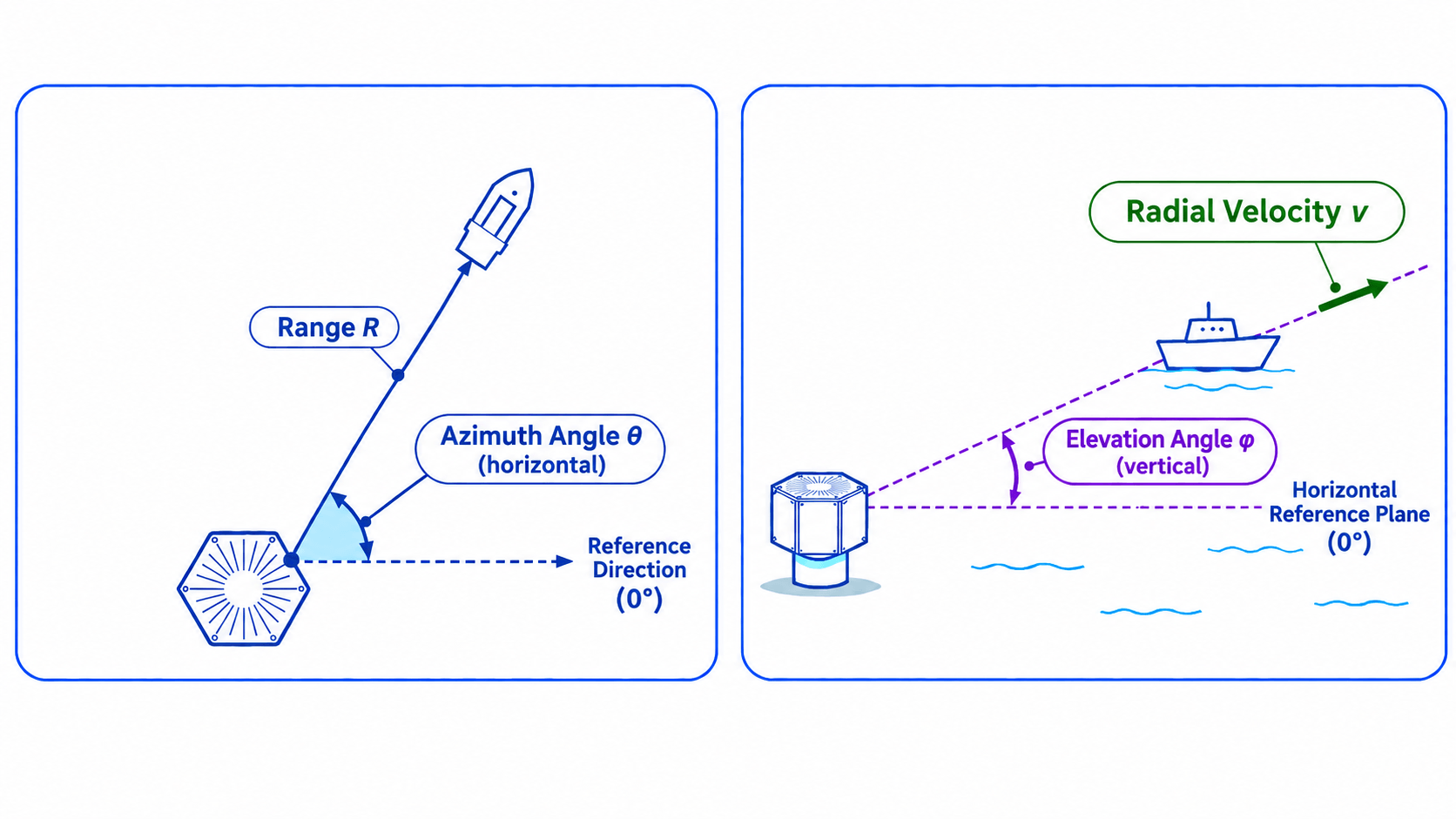
Through these four dimensions, the BOTIX XSeek captures a target's spatial position and radial motion information simultaneously, providing a richer data foundation for perception.
What Does 4D Add Compared with Conventional Navigational Radar?
Conventional navigational radar presents a two-dimensional picture of the surface situation mainly through range and azimuth information, and generally has no independent capability to measure elevation. At the same time, its range and azimuth resolution limits make it difficult to clearly resolve adjacent targets at close range, or their contour details. By contrast, the BOTIX XSeek not only acquires target information with higher range and angular resolution, but also measures the target's elevation in the vertical direction directly, yielding richer three-dimensional spatial information that underpins fine-grained target imaging. As for velocity measurement, most conventional navigational radars cannot measure velocity directly; the motion state has to be derived from successive scans and target tracking. The BOTIX XSeek obtains Doppler radial velocity directly and, combined with spatial position information, provides richer data support for determining a target's motion state and for continuous tracking.
How BOTIX Turns 4D Information into Stronger Perception
4D imaging adds measured information about targets, but turning that information into situational awareness on the water requires supporting innovation in both hardware and algorithms.
BOTIX combines high-gain narrow-beam antenna technology, a sparse two-dimensional MIMO array and a mechanically scanned multi-panel antenna architecture, addressing technical challenges including inter-channel phase drift, synchronization between antenna panels and real-time vessel-attitude compensation, and maintaining stable, accurate angular point-cloud output with sufficient effective point density. In parallel, an integrated, scene-adaptive processing pipeline — covering point-cloud stitching, noise filtering, segmentation, clustering and automatic multi-target tracking — processes the multidimensional echo information received by the radar, turning raw echo data into clear and stable target imaging.
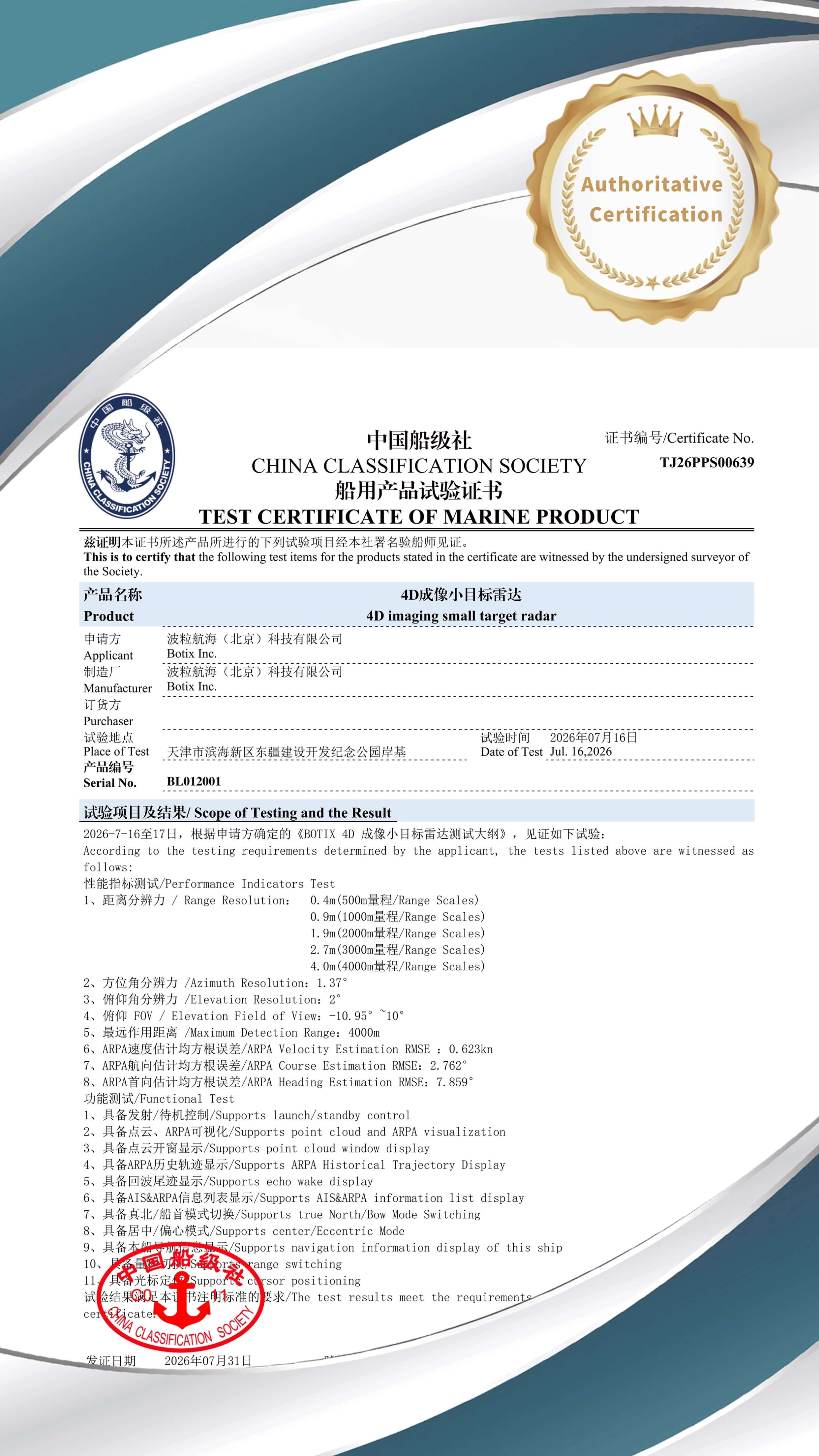
Tested and verified by China Classification Society (CCS), which issued the Marine Product Test Certificate, the results show that at a 500 m range scale the BOTIX XSeek achieves a range resolution of 0.4 m, an azimuth resolution of 1.37°, an elevation resolution of 2° and an elevation field of view of −10.95°~10°; the velocity root-mean-square error is 0.623 kn, and the maximum detection range reaches 4 km.
How Does the BOTIX XSeek Perform in Practice?
Take a berthing operation by a small tug of approximately 40 metres in length as an example.
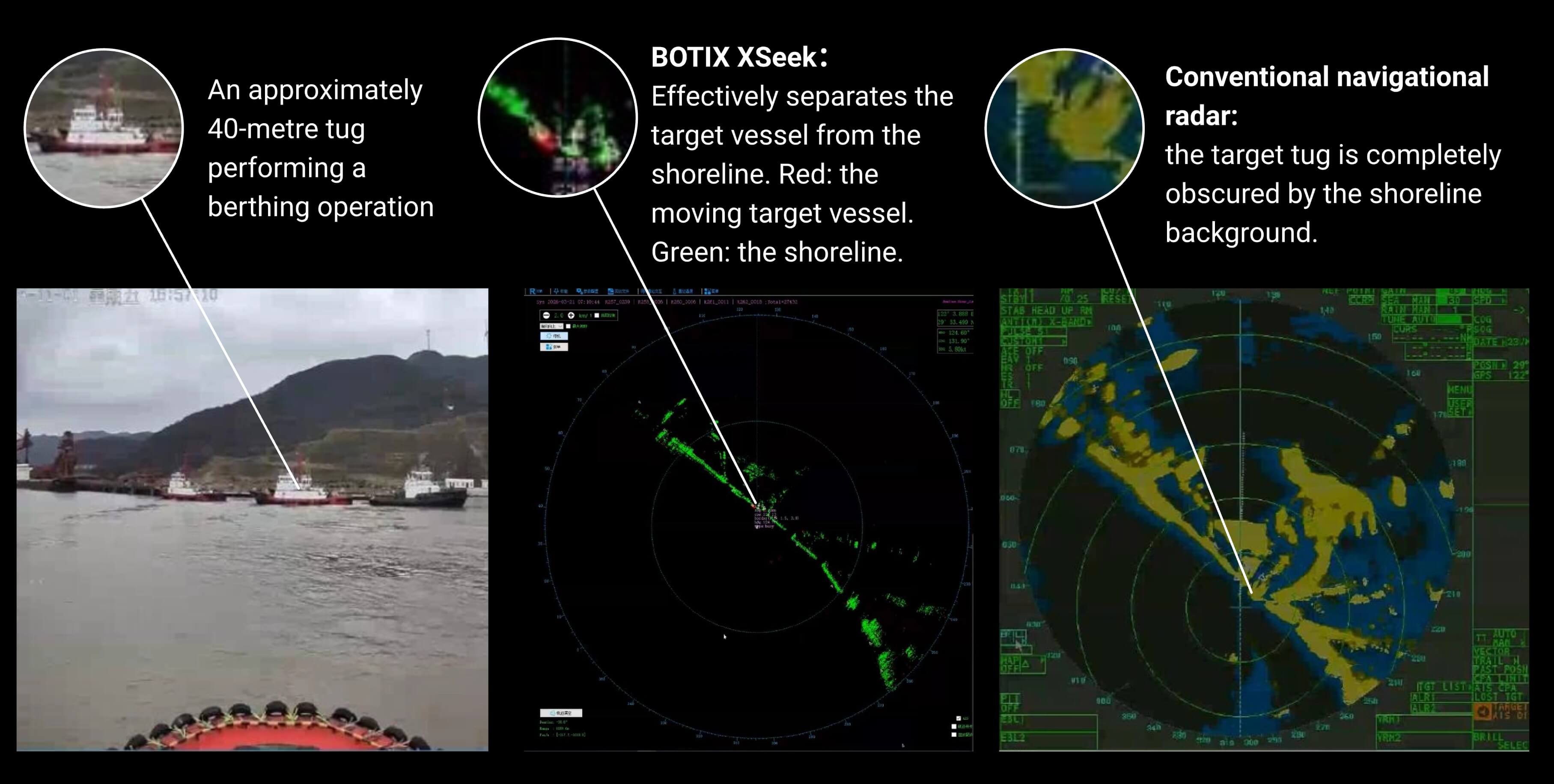
As the tug draws closer to the shoreline and the gap between vessel and shore keeps closing, the sensing precision required of the surrounding environment rises accordingly. On the display of a conventional navigational radar, the echoes of the tug and the shoreline gradually merge, target boundaries become indistinct, and the target is easily lost. By contrast, the BOTIX XSeek tracks the target tug steadily. When the vessel approaches the shoreline at low speed and performs berthing, the XSeek can distinguish the tug's echoes from those of the shoreline, providing clearer perception information for precision ship handling.
In Closing
Think of a vessel's above-water perception system as a team working together in a coordinated operation. Conventional navigational radar takes on the watch over the whole scene, giving the ship an overall picture of the surrounding waters; the BOTIX 4D Imaging Small-Target Radar XSeek focuses on close-range observation of fine detail, using high-resolution imaging to identify small targets nearby. The two bring complementary strengths and work in concert — from grasping the situation at long range, to detecting small targets up close — further extending the vessel's situational awareness and providing a dependable foundation for safer navigation and the intelligent development of shipping.



Read More
-
 Oct 20.2026BOTIX Showcases Full-Stack Maritime Autonomy Technologies at the 4th Fujian International Maritime Equipment Expo 2026Company News
-
 Aug 04.2026BOTIX XSeek 4D Imaging Small-Target Radar Receives CCS Marine Product Test CertificateProducts & Technology
-
 Apr 27.2026Reliable Perception When It Matters: XSeek 4D Imaging Small Target Radar for Safer NavigationProducts & Technology




 contact@botix.com


